Monday, 9 September 2013

Superlative TV


Send these guys something, theme apathy, if you can be bothered ;)

http://superlativetv.com/


Philip Baljeu's Video Kaleidoscope Tutorial

I recently featured Philip's great work here and now he has posted a good tutorial on using mirrors with video feedback to achieve more interesting results, a technique that allot of artists have employed in different ways. http://ruinelectronics.com/?p=225


if you use this be sure to link his tutorial

Conservation of Electronic & Experimental Film & Video

 Conservation is a difficult thing when it comes to experimental work that by it's very nature can be created through delicate transient systems whose functions are often based on specific properties of the medium that the artist/technician choses to work in. In addition to the fragile nature of the synthesis or animation systems used to create the work pretty much every recording media from modern film stock through magnetic video to CRT tubes, are decaying. In addition to this decay items like CRT tubes are being supplanted by other technologies and whilst the potential to manufacture one off custom replacements is always there and yes you could make a small production run of colour 35mm film it will usually not be economically viable and over and above this the accuracy, experience of the industry and calibration of mass produced components and film stock means that it would be very unlikely you would end up with a comparable tool. These issues are also very present in computer and online work and are probably compounded a million times when discussing anything as medium specific as glitch work which usually relies on specific codec's, machines or a combination of the two. Another personal concern of mine is that institutions focus on preserving the 'spirit' of the work rather than slavishly preserving the exact technical specification or indeed remake the work in a completely unsympathetic way 'faking' or replacing real 'honest' processes. Another concern of mine with the democratisation of digital and electronic art and artists with non academic backgrounds creating amazing work (which has always been the case there are just way more of them now) I think it's important for conservators to really understand the technical side of the process to inform their decisions when choosing what to do about conserving work from an artist who may not have given any instructions of what the conceptual core of the work is (there may not be any) That said I think most conservators in this field are pretty amazing at doing just that and here are some recent examples I have been show of interesting projects some of which I am sure you will have already seen.

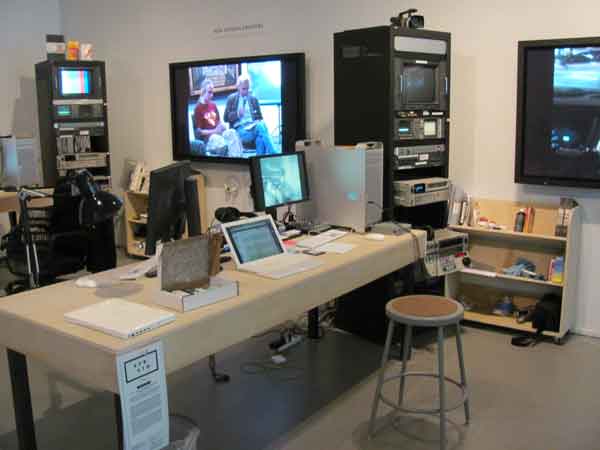
The XFR STN project at  the New Museum,  now finished is one of the coolest projects.
http://xfrstn.newmuseum.org Basically the project makes available a conservation technician and a whole load of equipment that allows anyone with content on obsolete media formats to come and get a conversion done as well as then creating an archive of the content collected which will be made available on archive.org, amazing really and some great work has come to light already even though the project has only just finished.


Dov Jacobson's Human Vectors is one of the stand out pieces 
also these links are interesting

Here is a collection of videos from Smithsonian American Art Museum about conserving and recreating Nam June Paik's work, a difficult task and one not devoid of irony as Paik's with his fluxus and performative background would probably be amused at the efforts undertaken to maintain his more transient work's in a frozen from, all the same amazing work. 


and another video from MOMA Conservation


At the end of the month I am going to see a CVM screening at the Tate going to try and make the Bristol one too, which includes some of the centres most recently conserved new discoveries and restorations, without conservation work of this type I doubt I would get to see any of this sort of work. Can't wait to see the Jordan Belson and Fischinger work.


It will be interesting to see what gets done about data corruption destructural, self destructive and work based around decay like Decasia (excerpt embedded below) or VHS generation loss based work or allot of circuit bent and glitch based work? how do we conserve work that destroys itself and should we?


On the other hand many experimental artist's and film makers are incredibly secretive about their techniques (I'm looking at you Belson) and while I am personally all for sharing everything including my techniques, I can see secrecy as a strategy to try and prevent or slow down commodification of your output might work (and can also make you seem like some transcendental visual wizard). While I find film, video and hardware conservation amazing there is still something slightly unsettling about it, maybe too much documentation analysis and maintenance misses the point of allot of this work or maybe without the obsessives that go to far we wouldn't have the skills in the industry to do any conservation and I would never have seen some of my favourite work? 

also organisations of note, might add more when I remember them
http://www.cinecon.org/ 

thanks to John, Philip Camila and people on varous forums for links to work ect


Friday, 6 September 2013

Antonio Roberts Hellocatfood

Antonio Roberts has been making interesting work for a long time now, more info on his site,
http://www.hellocatfood.com/ http://hellocatfood.tumblr.com/ he combines both hardware and computer based processes with a deft hand.


"The first output from a visuals jam session with Gabriella Gardosi/Gaia Gaoi whilst she was in the UK. She drew abstract forms using the Tagtool which I then uikdusahdisalhg4 messed with using a Panasonic WJ-AVE5 video mixer."


more

and more

a really nice example of how video bending works


catch him soon at SuperByte 2013 

Monday, 2 September 2013

Margaret Watts-Hughes and the Eidophone

Back many years ago now when I was beginning to research drawn sound work more heavily Rob Mullender very kindly let me look at the Oramics machine up close in his workshop (I think Mick Grierson who let me look at the Oramics archive also had something to do with it but I am a sieve brain) Rob makes some very cool work which deserves it's own post (and will get one some day soon) but I couldn't resist re blogging and adding to his post on Margaret Watts-Hughes a very early cymatics pioneer. Please visit Robs blog and check out his links as he plumbs some really interesting audio visual depths and returns from the mines with some rare gems!

https://vimeo.com/user3179219

Margaret Watts-Hughes was a Welsh soprano who gave up singing when she married, to concentrate on philanthropy and scientific research. Her Eidophone images developed in 1885 resulted from experiments with measuring the intensity of voice through vibration of seeds on a membrane, she then developed this process to enable her to capture images and as Rob points out also created some early time based media as she began dragging the Eidophone's membrane across the glass as she sang creating a sort of "proto optical sound recordings; although admittedly not in an analytically useful sense like the 'Phonautograph's', but rather more beautiful" Very Pioneering work. 


Other sources:
https://sites.google.com/site/appliedbiophysicsresearch/sound/cymatics/margaret-watts-hughes
http://www.cymascope.com/cyma_research/history.html
http://www.lumen.nu/rekveld/wp/?p=438
http://www.frankperry.co.uk/Cymatics.htm
http://www.gwrando.org/FindingRhayader.html
http://www.unz.org/Pub/Century-1891may-00037
http://timberwolfhq.com/cymatics-sacred-geometry-dna/
http://books.google.co.uk/books?id=zMXwMgEACAAJ&dq=Margaret+Watts-Hughes&hl=en&sa=X&ei=I8gkUq2cLuP17AbuqoCQDQ&ved=0CCQQ6AEwAA

THE WIRE SALON: VISUAL MUSIC AND SONIC IMAGES: NAM JUNE PAIK, CHARLOTTE MOORMAN AND EARLY VIDEO ART-MUSIC

ANGRY I AM MISSING THIS

Monday 2nd September 2013

Door Times : 8pm


When affordable video technology arrived in the 1960s, it was welcomed not only by visual artists wanting to work with moving images and noise, but also by musicians wanting to visualise sound. In fact, many of the earliest video artists began their careers as musicians: Nam June Paik was an experimental composer; Steina Vasulka was a classical violinist; Robert Cahen trained in electroacoustic composition; and Tony Conrad was a member of The Theatre Of Eternal Music. These influential musicians ensured that early video developed into a highly sonic genre.

In the hands of these experimental composers, video enlarged the broader cultural and artistic climate of experimentation and inclusivity of the 1960s. In particular, the moving image technology encouraged expansive and interactive performance situations that challenged conventional methods of art and music consumption.

In this illustrated talk, Holly Rogers will explore the musicality of early video and its performance through the complex relationship and controversial collaboration of two of its most charismatic practitioners, the Korean artist Nam June Paik and avant garde cellist Charlotte Moorman, a collaboration that led not only to many interactive and highly influential events, but also to several arrests.

Holly Rogers is a composer, performer and Senior Lecturer in Music and Audio-Visual Media at the University of Liverpool. She is the author of several books on music and the moving image including Visualising Music: Audio-Visual Relationships In Avant-Garde Film And Video Art (2010) and Sounding The Gallery: Video And The Rise of Art-Music (2013).

The Wire Salon is a monthly series of events, hosted by The Wire magazine, dedicated to the fine art and practice of thinking and talking about music. The events consist of talks, panel discussions, film screenings and DJ sets.

Mátyás Csiszár & Attila Kujbus

Some feedback work here from Mátyás Csiszár and Attila Kujbus
syncnoise.tumblr.com/
vintagedigitalism.hu/?p=282


VHS signal and noise experiment made by Mátyás Csiszár and Attila Kujbus.

Music:
Silf & Áron Birtalan - Wavelengths of Destruction pt. I

Technique:
Blaupunkt DVM-1000 mixer,
Sony XV-T500 Superimposer,
Sony XV-C700 Multi Color Corrector
and 2 video recorder.

and here is one more