Continuing the theme of effects videos, here is a nice one about 80s era video effects.
Showing posts with label video effects. Show all posts
Showing posts with label video effects. Show all posts
Monday, 31 August 2015

Sunday, 21 June 2015
Dan Bucciano
Dan Bucciano recently posted this fantastic clip to the discussion group so I thought I would share. It's some lovley black and white feedback processed with a color solarizer prototype he designed around 20 years ago.
Thursday, 8 January 2015
Denise Gallant, Satellite 1986
"Inspired by the book "Voyage to Acturus", Satellite was released in 1986. This 34 minute video was produced by Denise Gallant with a grant from the American Film Institute and National Endowment For The Arts."
Friday, 14 February 2014
Bermuda Triangle Lovely Audio Visual Extravaganza featuring James Alec Hardy
He so James gave me the heads up about this great event this Saturday for the benefit of Resonance104.4fm
He will be presenting the first performance of his Ziggurat 00120140215 broadcast system around 20:30ish here is a little sneak preview
and the rest of the audio visual line up looks great too
When: Saturday 15th February 2014 8pm - 2am
Where: Roxy Bar & Screen, 128-132 Borough High St, London SE1 1LB
Door: £5 donation to Resonance104.4fm
He will be presenting the first performance of his Ziggurat 00120140215 broadcast system around 20:30ish here is a little sneak preview
and the rest of the audio visual line up looks great too
When: Saturday 15th February 2014 8pm - 2am
Where: Roxy Bar & Screen, 128-132 Borough High St, London SE1 1LB
Door: £5 donation to Resonance104.4fm

Thursday, 23 January 2014
Friday, 27 September 2013
Bill Sebastian's Outer Space Visual Communicator
It's not often I come across such a unique hybrid instrument, the OCV by Bill Sebastian and eventually his company Visual Music Systems is a complex hybrid visual music machine with some very complex control interfaces. It incorporates both optical electromechanical light sources, electronic video effects and video generation and an incredibly complex interface system for intuitive instrumental control. The system has been adapted and added to over time extending it's original functionality while maintaining the beautiful imagery and excellent user control. So here is some information very kindly provided by Bill about his astounding and very unique visual instrument. (please excuse accuracy of the info as with such a complex system I may make mistakes or place the available images in relevant but not completely correct contexts)
http://visualmusicsystems.com

"The Original OVC built 1973-1978
Input devices (original system)
multi-touch keyboard using capacitance switches to support something similar to electronic finger painting,

as well as large numbers of switches, faders etc to control signal processing, 7 foot-pedals


Signal processing (original system)
signals processed by about 5000 separate TTL digital logic packages (DID YOU SAY 5000 BILL!) to build patterns, implement sequencers, and otherwise expand upon the multi-touch input. Total latency through processing system < 10 msecs, so that responses were as immediate as audio musical instruments, phase-controlled firing of projector lamps

above is a pic of 1 of 6 wire wrap boards, each with about 750 ICs.!


high contrast: performed in optically controlled environments (absolutely no light other than display) so that sections of performances were done in scotopic range (where luminance is too low for retina cones to function), so that we could explore the bottom threshold of visual perception. Concerts usually began at those levels and remained there long enough for the photoreceptor chemicals to adjust for maximum sensitivity, so that when we moved up to higher brightness levels, colors were generated that are not possible under normal lighting conditions

"Funniest moment in that process was once when we had a short between ground and VCC, which could be anywhere on board.Couldn't find it after half a day of searching. So we took the VCC & ground (no ICs were installed at this point) and plugged into 110VAC. Got a nice 'POP' and then had to do 1/2 hour of cleanup repair." (brilliant!)

Real-time video synthesis experiments 1980-1985
Input devices
used original OVC, but played with only 1 hand, as 2nd hand used control video equipment
video control system that allowed controlling cameras, optical effects, etc. with 1 hand
mouth controller that controlled 18x3 channel RGB mixing board using something like a 3D harmonica
Signal processing (video synthesis experiments) - added to the orignal OVC system:
The other low-level source is a line generator.It doesn't make a good dancer, but worked well with the kaleidoscope processor to provide a nice background texture to counterbalance the blobs."

To add a short extra interesting bit of information to this story the OVC was primarily if not exclusively used with the amazing Sun Ra and his Arkestra (can you think of a better partner for these visuals)


http://visualmusicsystems.com

"The Original OVC built 1973-1978
Input devices (original system)
multi-touch keyboard using capacitance switches to support something similar to electronic finger painting,

as well as large numbers of switches, faders etc to control signal processing, 7 foot-pedals


Signal processing (original system)
signals processed by about 5000 separate TTL digital logic packages (DID YOU SAY 5000 BILL!) to build patterns, implement sequencers, and otherwise expand upon the multi-touch input. Total latency through processing system < 10 msecs, so that responses were as immediate as audio musical instruments, phase-controlled firing of projector lamps

above is a pic of 1 of 6 wire wrap boards, each with about 750 ICs.!
Display (original system)
12 foot diameter hexagonal display curved as if looking at 10% of the inside of a sphere
rear projection using 3 primary filtered lamps per segment. 91 segments.
12 foot diameter hexagonal display curved as if looking at 10% of the inside of a sphere
rear projection using 3 primary filtered lamps per segment. 91 segments.


high contrast: performed in optically controlled environments (absolutely no light other than display) so that sections of performances were done in scotopic range (where luminance is too low for retina cones to function), so that we could explore the bottom threshold of visual perception. Concerts usually began at those levels and remained there long enough for the photoreceptor chemicals to adjust for maximum sensitivity, so that when we moved up to higher brightness levels, colors were generated that are not possible under normal lighting conditions

"Funniest moment in that process was once when we had a short between ground and VCC, which could be anywhere on board.Couldn't find it after half a day of searching. So we took the VCC & ground (no ICs were installed at this point) and plugged into 110VAC. Got a nice 'POP' and then had to do 1/2 hour of cleanup repair." (brilliant!)

Real-time video synthesis experiments 1980-1985
used original OVC, but played with only 1 hand, as 2nd hand used control video equipment
video control system that allowed controlling cameras, optical effects, etc. with 1 hand
mouth controller that controlled 18x3 channel RGB mixing board using something like a 3D harmonica
Signal processing (video synthesis experiments) - added to the orignal OVC system:
optical video effects, such as 6 foot long front-surface mirrors with 4 axis servo control over camera at one end and 2 axis control over monitor at other 18x3 channel RGB analog video mixing system, with 6 level depth controls per channel
I asked Bill about the complex lines generated in the mandala like structures and he very kindly replied
"There are actually 2 low-level image sources in the the videos, both of which go through the optical
kaleidoscope feedback processor. The blob-like shapes are coming from a video camera pointed at the original OVC. If you look closely at the them in some places you can actually notice that is a hand doing multitouch fingerpainting.The other low-level source is a line generator.It doesn't make a good dancer, but worked well with the kaleidoscope processor to provide a nice background texture to counterbalance the blobs."

To add a short extra interesting bit of information to this story the OVC was primarily if not exclusively used with the amazing Sun Ra and his Arkestra (can you think of a better partner for these visuals)
and Bills work is mentioned in the excellent book How To Wreck A Nice Beach which I am yet to dig in to. Bill apparently is also a keyboardist/synthesist and built much of the OVC in a basement at MIT as well as a barn in Ore City, Texas. The OVC would later go on to be referenced in the pioneering early Hip Hop classic from Jonzun Crew "Pac Jam Look Out for The OVC"
The lineage of Sun Ra's direct influence on the cosmic aspect of early hip hop can clearly be seen with the OVC being a link in that chain (detailed in a few places linked below in a far more knowledgeable way than I could ever do). Bills 3D system - started construction as of Jan, 2011 and is still under progress see coverage on web site!
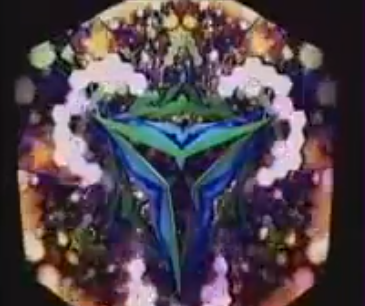

Ill Leave you with Sun Ra and the OVC
http://visualmusicsystems.com/OVC.html
http://www.libraryofvinyl.org/tag/sun-ra/
http://howtowreckanicebeach.com/?p=197
http://www.thafoundation.com/jonzun.htm
http://visualmusicsystems.com/OVC.html
http://www.libraryofvinyl.org/tag/sun-ra/
http://howtowreckanicebeach.com/?p=197
http://www.thafoundation.com/jonzun.htm
Wednesday, 25 September 2013
Saturday, 3 August 2013
Thursday, 31 January 2013
Saturday, 29 December 2012
April Greiman
After looking at book on April Greiman an idea I have been thinking about for a while now was confirmed, that is that some aesthetics in design and art are dictated by the technology of the time (I know this is obvious) and that video technology arrived just before computers in terms of easily available image generation/manipulation tools. The book showed some images Greiman created just before she got access to a Mac using Calarts Grassvally switcher and some video/audio synthesisers. Greiman's work went on to become incredibly influential, she is one of the designers credited with brining 'New Wave' style to America and her unique experimental work influenced many other designers for the next decade and beyond, her utilisation of pixelation and other digitization errors was also ahead of her time.
http://aprilgreiman.com/
http://en.wikipedia.org/wiki/April_Greiman
http://nicolajaynesullivan.blogspot.co.uk


http://aprilgreiman.com/
http://en.wikipedia.org/wiki/April_Greiman
http://nicolajaynesullivan.blogspot.co.uk
Saturday, 17 November 2012
Simulcast
Simulcast shows some subtle uses of the entrancer here with varied source marital
"Simulcast is a one-man-audiovisual-experimentation-unit.
He has been producing music and visuals since 2002.
He is based in Brisbane, Australia."
.
"Simulcast is a one-man-audiovisual-experimentation-unit.
He has been producing music and visuals since 2002.
He is based in Brisbane, Australia."
.
Saturday, 13 October 2012
EL PERRO DEL MAR - WALK ON BY
A MUSIC VIDEO BY FRODE & MARCUS FOR EL PERRO DEL MAR - WALK ON BY
MORE INFORMATION:
elperrodelmar.com/
ingmarservices.com/
ingrd.com/
frodemarcus.com
The video features video synth effects by the technical wiz Ruben Broman and his homemade machine.
Fashion by: A-S Dåvik
Tuesday, 29 May 2012
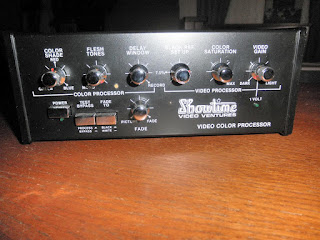
Showtime Video Equipment
Various Pics from ebay auctions of rare Showtime/Magnavox video effects equipment




Wednesday, 29 February 2012
Monday, 16 January 2012
Old shots of Lucky PDF karaoke with Taki and Lucy
I helped out my friends Taki and Lucy in creating a live video effects karaoke piece as a small part of Lucky PDF Live at Frieze art fair. I just provided the live equipment set up and they did all the hard work as I was out of the country during most of the show, but I did get a chance to snap a few shots of the set up before I went.


also Lucky PDF have been nominated for this art prize so if you are in the mood please vote for them as they are hard working and all round nice guys
Tuesday, 8 November 2011

Saturday, 10 September 2011
John Foxx
Recently super nice guy and talented Graphic designer Jonathan Barnbrook asked me to help him out with including some analogue and hardware based effects on a video he was putting together for John Foxx, here are the results (mostly Jonathan's hard work with some image processing by me)
It was a great experience to work on
Friday, 8 July 2011
Barry Schrader: Moon-Whales
"This video is from a 1985 concert at CalArts that dealt with real-time video processing of live performances. This is the final movement of Schrader's "Moon-Whales and Other Moon Songs" (1982-83), based on poems by Ted Huges. Performers include Maurita Phillips-Thormburgh, soprano, and Michael Scroggins, live video processing. The electronic music was created on a Buchla 200 system (Electric Music Box)."
from ExMachinaPub
Sunday, 22 May 2011
Friday, 1 April 2011
Suburban Lawns 'Janitor' Video By Denise Gallant
Subscribe to:
Posts (Atom)