Showing posts with label video synthesis. Show all posts
Wednesday, 12 July 2017
Photos From The Video Workshop
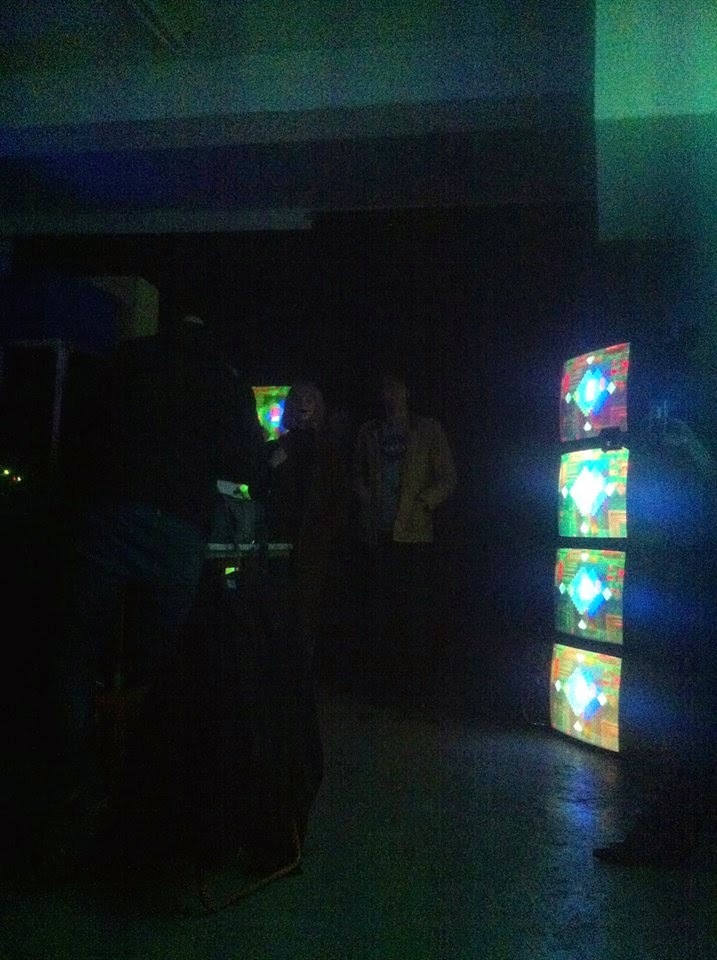
The video workshop Alex and I gave was one of the best I have delivered, all 15 attendees got to take home a working CHA/V module they built in the class, it's a hacked VGA signal generator that basically allows you to build a simple video synth by adding some home brew or off the shelf oscillators. We had a great mix of attendees and they were all from really interesting backgrounds and super engaged. Alex as usual did a nicely paced video synthesis tutorial and I then lead the theory and building part of the class. We rounded up with Alex leading a discussion around historical video synthesis work and then proceeded to enjoy the evening concerts that were also part of the fantastic Brighton modular meet. (Pics 3+9 here are from Fabrizio D'Amico who runs Video Hack Space) Thanks to Andrew for organising the amazing meet which hosted the workshop, Matt for making our panels last minute, George for helping us out on the day and Steve from Thonk for supplying some components for the kits.


Labels:
DIY,
diy kit,
live video,
VGA,
video synth,
video synthesis,
video synthesizer,
workshop
Friday, 1 July 2016
Video Circuits Room at Brighton Modular Meet
Alexander Peverett and I will be looking after a Video Synthesis room at Brighton Modular Meet this weekend. Come down to chat about video synthesis and our strange love for CRT tubes :) there will be at least 6 sony PVMs on display! along with a few systems and unusual bits of video gear. I am super excited that Nitin AKA Bradford Bahamas will be bringing his incredible playable CRT rig.
brightonmodularmeet.co.uk
Invited to be part of the 2016 International Conference on Live Interfaces (http://www.liveinterfaces.org/) at the University of Sussex, this years Brighton Modular Meet takes place in the newly renovated Attenborough Centre for the Creative Arts (formerly the Gardner Arts Centre). We will be taking over a number of rooms in this Grade 2 listed building designed by Sir Basil Spence.
In addition to a large open access space where you can set up your synth and mingle with others, this year we will have a room for manufacturers and shops, a space for talks and live performances, and a video synthesis room.
brightonmodularmeet.co.uk
Invited to be part of the 2016 International Conference on Live Interfaces (http://www.liveinterfaces.org/) at the University of Sussex, this years Brighton Modular Meet takes place in the newly renovated Attenborough Centre for the Creative Arts (formerly the Gardner Arts Centre). We will be taking over a number of rooms in this Grade 2 listed building designed by Sir Basil Spence.
In addition to a large open access space where you can set up your synth and mingle with others, this year we will have a room for manufacturers and shops, a space for talks and live performances, and a video synthesis room.
Labels:
live video,
video art,
video synth,
video synthesis,
video synthesizer
Sunday, 26 June 2016
Friday, 20 May 2016
Video Synthesis Techniques
So I am doing a talk at Raven Row as part of their very lovely exhibition of Steina & Woody Vasulka's work, will be demoing some of the techniques they used to make their work. Hopfully it will be interesting.
"Chris King: Video Circuits
Thursday 2 June, 6.30pm
Artist Chris King leads a live demonstration of early media art and video synthesis technologies, working with a selection of different techniques used by the Vasulkas and other video artists during the 1970s and 80s.Chris King: Video Circuits
Thursday 2 June, 6.30pm
Artist Chris King leads a live demonstration of early media art and video synthesis technologies, working with a selection of different techniques used by the Vasulkas and other video artists during the 1970s and 80s."
http://www.ravenrow.org/events/chris_king_video_circuits/
"Chris King: Video Circuits
Thursday 2 June, 6.30pm
Artist Chris King leads a live demonstration of early media art and video synthesis technologies, working with a selection of different techniques used by the Vasulkas and other video artists during the 1970s and 80s.Chris King: Video Circuits
Thursday 2 June, 6.30pm
Artist Chris King leads a live demonstration of early media art and video synthesis technologies, working with a selection of different techniques used by the Vasulkas and other video artists during the 1970s and 80s."
http://www.ravenrow.org/events/chris_king_video_circuits/
Thursday, 24 March 2016
Seeing Sound
I will be giving a talk on some research I have been doing into early British video synthesis and electronic video work at this years Seeing Sound. I will also be screening some work from some contemporary Video Circuits Regulars as part of the conference.
www.seeingsound.co.uk Sign up here!
Labels:
Britain,
screening,
video art,
video art history,
video history,
video synthesis
Wednesday, 27 January 2016
Tuesday, 6 October 2015
Experiments using the Rutt-Etra Analog Video Synthesizer and Siegel colorizer, 1975
Video Synthesis Experiments, excerpts from Edin Velez on vimeo.
A rare example of the Siegel Colorizer in use in this short excerpt.
http://edinvelez.com
A rare example of the Siegel Colorizer in use in this short excerpt.
http://edinvelez.com
Labels:
colorizer,
Colouriser,
colourizer,
Rutt-Etra,
video art,
video synthesis
Thursday, 30 April 2015
Psyché Tropes + Video Circuits
Here are a few images from the night we did a while back and some video shot by Video Hack Space! thanks Fabrizio!
Tuesday, 24 March 2015
Psyché Tropes & Video Circuits present an Evening of Modular Synthesis April the 4th
So I got together with Psyché Tropes to put on an event at apiary studios on the 4th of April, it should be interesting and mostly modular! There will be me and two of my favourite video syntheists doing video and three great musicians doing audio, hopefully with some cross patching for added fun and audio reactivity.
Psyché Tropes and Video Circuits present an Evening of Modular Synthesis at Apiary Studios on Saturday 4th April 2015.
£6 adv / £8 door. No guest list. 8pm – Late.
Tickets: http://www.wegottickets.com/event/310502
Psyché Tropes is a label from the creator of Hackney Film Festival dedicated to exploring the synaesthetic intersections between sound and its visual counterpart. The label’s second live edition sees a collaborative event with Video Circuits combining the realms of audio and video modular synthesis with a very special line-up. Video Circuits is a blog and research project that takes a wide ranging approach to documenting the early years of electronic video art, visual music and computer art with a view to informing the current output of contemporary artists and musicians working in the field.
Live modular shows by
SCANNER
AUDIO DEPENDENT
THE ASTERISM
Live video modular by
ALEXANDER PEVERETT
SYNTHPUNK
CHRIS KING
with Psyché Tropes djs
SCANNER
British artist Robin Rimbaud traverses the experimental terrain between sound, space, image and form, creating absorbing, multi-layered sound pieces that twist technology in unconventional ways. From his early controversial work using found mobile phone conversations, through to his focus on trawling the hidden noise of the modern metropolis as the symbol of the place where hidden meanings and missed contacts emerge, his restless explorations have won him international admiration from amongst others, Bjork, Aphex Twin and Stockhausen.
http://scannerdot.com/
AUDIO DEPENDENT
Audio Dependent is the electronic music alias of audio visual artist, Tim Cowie. A long-time collaborator at The Light Surgeons, Cowie’s music and sound design work crosses over from electronica and techno, to contemporary classical and ambient soundscapes. He also releases music under his own name and as part of the duo Infinite Particles.
https://soundcloud.com/audio-dependent
THE ASTERISM
The Asterism is a semi-improvised solo modular synth and electronics project from Mark O Pilkington (Raagnagrok / Urthona / Teleplasmiste), constructed around organic rhythmic developments and blurring the lines between natural and unnatural sounds.
https://soundcloud.com/the-asterism
ALEXANDER PEVERETT
Alexander Peverett (b.1976) is a multi-disciplinary artist from Wigan, England. He resides in Japan and the United Kingdom. His personal work explores the fields of electronic & computer music, video art, multi-media installation, generative art and computer graphics. He works as a freelance Art Director, Computer Artist, Sound Designer and Video Director.
http://alexanderpeverett.com/
SYNTHPUNK
Synthpunk is a musician, engineer and video synthesist. His wide ranging skills and interests manifest themselves in many different ways one of which is his self-built modular video synthesizer.
http://synth-punk.blogspot.co.uk/
CHRIS KING
Chris King is an audio visual artist who primarily works with drawing, experimental animation, electronics and sound.
http://videocircuits.blogspot.co.uk/
More info at:
http://psyche-tropes.com/
http://www.apiarystudios.org/
http://videocircuits.blogspot.co.uk/
£6 adv / £8 door. No guest list. 8pm – Late.
Tickets: http://www.wegottickets.com/event/310502
Psyché Tropes is a label from the creator of Hackney Film Festival dedicated to exploring the synaesthetic intersections between sound and its visual counterpart. The label’s second live edition sees a collaborative event with Video Circuits combining the realms of audio and video modular synthesis with a very special line-up. Video Circuits is a blog and research project that takes a wide ranging approach to documenting the early years of electronic video art, visual music and computer art with a view to informing the current output of contemporary artists and musicians working in the field.
Live modular shows by
SCANNER
AUDIO DEPENDENT
THE ASTERISM
Live video modular by
ALEXANDER PEVERETT
SYNTHPUNK
CHRIS KING
with Psyché Tropes djs
SCANNER
British artist Robin Rimbaud traverses the experimental terrain between sound, space, image and form, creating absorbing, multi-layered sound pieces that twist technology in unconventional ways. From his early controversial work using found mobile phone conversations, through to his focus on trawling the hidden noise of the modern metropolis as the symbol of the place where hidden meanings and missed contacts emerge, his restless explorations have won him international admiration from amongst others, Bjork, Aphex Twin and Stockhausen.
http://scannerdot.com/
AUDIO DEPENDENT
Audio Dependent is the electronic music alias of audio visual artist, Tim Cowie. A long-time collaborator at The Light Surgeons, Cowie’s music and sound design work crosses over from electronica and techno, to contemporary classical and ambient soundscapes. He also releases music under his own name and as part of the duo Infinite Particles.
https://soundcloud.com/audio-dependent
THE ASTERISM
The Asterism is a semi-improvised solo modular synth and electronics project from Mark O Pilkington (Raagnagrok / Urthona / Teleplasmiste), constructed around organic rhythmic developments and blurring the lines between natural and unnatural sounds.
https://soundcloud.com/the-asterism
ALEXANDER PEVERETT
Alexander Peverett (b.1976) is a multi-disciplinary artist from Wigan, England. He resides in Japan and the United Kingdom. His personal work explores the fields of electronic & computer music, video art, multi-media installation, generative art and computer graphics. He works as a freelance Art Director, Computer Artist, Sound Designer and Video Director.
http://alexanderpeverett.com/
SYNTHPUNK
Synthpunk is a musician, engineer and video synthesist. His wide ranging skills and interests manifest themselves in many different ways one of which is his self-built modular video synthesizer.
http://synth-punk.blogspot.co.uk/
CHRIS KING
Chris King is an audio visual artist who primarily works with drawing, experimental animation, electronics and sound.
http://videocircuits.blogspot.co.uk/
More info at:
http://psyche-tropes.com/
http://www.apiarystudios.org/
http://videocircuits.blogspot.co.uk/
Monday, 2 March 2015
C.E. Burnett
A recent article on Paleofuture brought to my attention the work of C.E. Burnett an engineer at RCA's research lab during the 1930s. This must be a very early example of cathode ray tubes being used for pattern generation and certainly predates many more well known media art pioneers. I wonder if he ever spoke to Ben F. Laposky another early pioneer in a related technique.
sources:
https://books.google.co.uk/books?id=vSgDAAAAMBAJ&printsec=frontcover&source=gbs_ge_summary_r&cad=0#v=onepage&q&f=false
http://www.americanradiohistory.com/Archive-Radio-Craft/1930s/Radio-Craft-1938-07.pdf
sources:
https://books.google.co.uk/books?id=vSgDAAAAMBAJ&printsec=frontcover&source=gbs_ge_summary_r&cad=0#v=onepage&q&f=false
http://www.americanradiohistory.com/Archive-Radio-Craft/1930s/Radio-Craft-1938-07.pdf
Labels:
1930s,
RCA,
video art,
video art history,
video synth,
video synthesis,
video synthesizer
Monday, 3 November 2014
Peter Chamberlain
Peter C has uploaded some amazing work from earlier in his career.
Wednesday, 8 October 2014
Why Not, Jim Sosnin (1980)
A recent upload by Jim Sosnin drawn to my attention by the ever vigilant Jeffrey
http://www.australianmusiccentre.com.au/artist/sosnin-jim
"Video synthesis demo from 1980, realised using EMS Spectron video synth plus some homebrew gear. The audio was created in 1978 using 3 Transaudio synths linked together. This digital transfer via an old U-matic (3/4-inch format) VCR, repaired for the occasion, to retrieve original stereo audio (my more recent VHS copy had mono audio only)."
http://www.australianmusiccentre.com.au/artist/sosnin-jim
"Video synthesis demo from 1980, realised using EMS Spectron video synth plus some homebrew gear. The audio was created in 1978 using 3 Transaudio synths linked together. This digital transfer via an old U-matic (3/4-inch format) VCR, repaired for the occasion, to retrieve original stereo audio (my more recent VHS copy had mono audio only)."
Labels:
australia,
EMS,
Spectre,
Spectron,
video art history,
video synthesis
Saturday, 19 April 2014
VIDEO CIRCUITS FILM NIGHT
So Ben from Cinematograph Film Club asked me to do a Video Circuits film night as part of his latest group of screenings, So I have put together a list of artists work that I will be screening on the night, I might bring down a CRT and some video gear for fun as well :3
Time 20:00
Date 27 April
Location The Duke Of Wellington, London N1
here is the facebook event link
cinematographfilmclub.tumblr.com
and here is a little experiment form my diy video synth
James Alec Hardy
Time 20:00
Date 27 April
Location The Duke Of Wellington, London N1
here is the facebook event link
cinematographfilmclub.tumblr.com
and here is a little experiment form my diy video synth
James Alec Hardy
http://sitbackandrelapse.webs.com/
Alexander Peverett
Alexander Peverett
http://alexanderpeverett.com/
Victoria Keddie & Scott kiernan
http://victoriakeddie.com/ http://www.scottkiernan.com/
Sabrina Ratte
Sabrina Ratte
http://sabrinaratte.com/
Marc Bascougnano
Marc Bascougnano
http://runningtimeblog.blogspot.com/
Philip Baljeu
Philip Baljeu
Friday, 27 September 2013
Bill Sebastian's Outer Space Visual Communicator
It's not often I come across such a unique hybrid instrument, the OCV by Bill Sebastian and eventually his company Visual Music Systems is a complex hybrid visual music machine with some very complex control interfaces. It incorporates both optical electromechanical light sources, electronic video effects and video generation and an incredibly complex interface system for intuitive instrumental control. The system has been adapted and added to over time extending it's original functionality while maintaining the beautiful imagery and excellent user control. So here is some information very kindly provided by Bill about his astounding and very unique visual instrument. (please excuse accuracy of the info as with such a complex system I may make mistakes or place the available images in relevant but not completely correct contexts)
http://visualmusicsystems.com
"The Original OVC built 1973-1978
Input devices (original system)
multi-touch keyboard using capacitance switches to support something similar to electronic finger painting,
as well as large numbers of switches, faders etc to control signal processing, 7 foot-pedals
Signal processing (original system)
signals processed by about 5000 separate TTL digital logic packages (DID YOU SAY 5000 BILL!) to build patterns, implement sequencers, and otherwise expand upon the multi-touch input. Total latency through processing system < 10 msecs, so that responses were as immediate as audio musical instruments, phase-controlled firing of projector lamps
above is a pic of 1 of 6 wire wrap boards, each with about 750 ICs.!
high contrast: performed in optically controlled environments (absolutely no light other than display) so that sections of performances were done in scotopic range (where luminance is too low for retina cones to function), so that we could explore the bottom threshold of visual perception. Concerts usually began at those levels and remained there long enough for the photoreceptor chemicals to adjust for maximum sensitivity, so that when we moved up to higher brightness levels, colors were generated that are not possible under normal lighting conditions
"Funniest moment in that process was once when we had a short between ground and VCC, which could be anywhere on board.Couldn't find it after half a day of searching. So we took the VCC & ground (no ICs were installed at this point) and plugged into 110VAC. Got a nice 'POP' and then had to do 1/2 hour of cleanup repair." (brilliant!)
Real-time video synthesis experiments 1980-1985
Input devices
used original OVC, but played with only 1 hand, as 2nd hand used control video equipment
video control system that allowed controlling cameras, optical effects, etc. with 1 hand
mouth controller that controlled 18x3 channel RGB mixing board using something like a 3D harmonica
Signal processing (video synthesis experiments) - added to the orignal OVC system:
The other low-level source is a line generator.It doesn't make a good dancer, but worked well with the kaleidoscope processor to provide a nice background texture to counterbalance the blobs."
To add a short extra interesting bit of information to this story the OVC was primarily if not exclusively used with the amazing Sun Ra and his Arkestra (can you think of a better partner for these visuals)
http://visualmusicsystems.com
"The Original OVC built 1973-1978
Input devices (original system)
multi-touch keyboard using capacitance switches to support something similar to electronic finger painting,
as well as large numbers of switches, faders etc to control signal processing, 7 foot-pedals
Signal processing (original system)
signals processed by about 5000 separate TTL digital logic packages (DID YOU SAY 5000 BILL!) to build patterns, implement sequencers, and otherwise expand upon the multi-touch input. Total latency through processing system < 10 msecs, so that responses were as immediate as audio musical instruments, phase-controlled firing of projector lamps
above is a pic of 1 of 6 wire wrap boards, each with about 750 ICs.!
Display (original system)
12 foot diameter hexagonal display curved as if looking at 10% of the inside of a sphere
rear projection using 3 primary filtered lamps per segment. 91 segments.
12 foot diameter hexagonal display curved as if looking at 10% of the inside of a sphere
rear projection using 3 primary filtered lamps per segment. 91 segments.
high contrast: performed in optically controlled environments (absolutely no light other than display) so that sections of performances were done in scotopic range (where luminance is too low for retina cones to function), so that we could explore the bottom threshold of visual perception. Concerts usually began at those levels and remained there long enough for the photoreceptor chemicals to adjust for maximum sensitivity, so that when we moved up to higher brightness levels, colors were generated that are not possible under normal lighting conditions
"Funniest moment in that process was once when we had a short between ground and VCC, which could be anywhere on board.Couldn't find it after half a day of searching. So we took the VCC & ground (no ICs were installed at this point) and plugged into 110VAC. Got a nice 'POP' and then had to do 1/2 hour of cleanup repair." (brilliant!)
Real-time video synthesis experiments 1980-1985
used original OVC, but played with only 1 hand, as 2nd hand used control video equipment
video control system that allowed controlling cameras, optical effects, etc. with 1 hand
mouth controller that controlled 18x3 channel RGB mixing board using something like a 3D harmonica
Signal processing (video synthesis experiments) - added to the orignal OVC system:
optical video effects, such as 6 foot long front-surface mirrors with 4 axis servo control over camera at one end and 2 axis control over monitor at other 18x3 channel RGB analog video mixing system, with 6 level depth controls per channel
I asked Bill about the complex lines generated in the mandala like structures and he very kindly replied
"There are actually 2 low-level image sources in the the videos, both of which go through the optical
kaleidoscope feedback processor. The blob-like shapes are coming from a video camera pointed at the original OVC. If you look closely at the them in some places you can actually notice that is a hand doing multitouch fingerpainting.The other low-level source is a line generator.It doesn't make a good dancer, but worked well with the kaleidoscope processor to provide a nice background texture to counterbalance the blobs."
To add a short extra interesting bit of information to this story the OVC was primarily if not exclusively used with the amazing Sun Ra and his Arkestra (can you think of a better partner for these visuals)
and Bills work is mentioned in the excellent book How To Wreck A Nice Beach which I am yet to dig in to. Bill apparently is also a keyboardist/synthesist and built much of the OVC in a basement at MIT as well as a barn in Ore City, Texas. The OVC would later go on to be referenced in the pioneering early Hip Hop classic from Jonzun Crew "Pac Jam Look Out for The OVC"
The lineage of Sun Ra's direct influence on the cosmic aspect of early hip hop can clearly be seen with the OVC being a link in that chain (detailed in a few places linked below in a far more knowledgeable way than I could ever do). Bills 3D system - started construction as of Jan, 2011 and is still under progress see coverage on web site!
Ill Leave you with Sun Ra and the OVC
http://visualmusicsystems.com/OVC.html
http://www.libraryofvinyl.org/tag/sun-ra/
http://howtowreckanicebeach.com/?p=197
http://www.thafoundation.com/jonzun.htm
http://visualmusicsystems.com/OVC.html
http://www.libraryofvinyl.org/tag/sun-ra/
http://howtowreckanicebeach.com/?p=197
http://www.thafoundation.com/jonzun.htm
Monday, 23 September 2013
Synthetics Aspects of Art and Technology in Australia, 1956-1975
Just been reading Stephen Jones (of Severed Heads) book on early Australian media art, It's kind of like the book I wish someone would write about the subject world wide but because it limits itself in scope by confining the subject to Australia and between 1956-1975 it actually deals with the mechanics of the work better more thoroughly explaining the significance connections and evolution of this type of work. Stephen also goes on to compare video to writing as the technology stems from encoding images of signatures down a single telegraph wire using synchronisation pulses to set the start of each line of an image, this is amazing to me as for a while now I have been giving talks explaining the relation of video to drawing and drawings links to writing so it was nice to read a really concise explanation of this linage similar to what I have been saying but backed up by the very roots of the technology. I had been explaining that a video image whether raster or vector drawn was actually linear in nature and then showing early sound and image recording technologies roots in drawing with examples such a the phonautograph. Australia made some big strides in media art and there are some amazing artists work dealt with here https://mitpress.mit.edu/books/synthetics.
More Jones inspired posts to follow at some point.
Saturday, 17 August 2013
Doron Abrahami
Doron Abrahami working using "electronic modulator" at the Royal College of Art TV studio 1975. There is not much info online, Abrahami is quoted in this classic David Hall article here http://www.luxonline.org.uk/articles/video_report(1).html although David dosn't seem to like synthetic work much :/
Labels:
audio visual,
video art,
video art history,
video synthesis
Friday, 9 August 2013
500!
Saturday, 20 July 2013
Blondes - Elise Video by Greg Zifcak & Will Rahilly
http://gzifcak.net
http://williamrahilly.com
nice video from these two
the bands blog here
http://blondeblondeblondes.tumblr.com/
and a full release
Blondes - UK / Europe Summer 2013 Tour
www.blondeblondeblondes.com
08-02 Katowice, Poland - OFF Festival
08-03 Olganitz, Germany - Nachtdigital
08-09 Barcelona, Spain - Razzmatazz
08-16 Berlin, Germany - Panoramabar
08-17 Bergen, Norway - Ostre
08-22 Edinburgh, Scotland - Sneaky Petes
08-23 Bristol, England - Start The Bus
08-24 Manchester, UK - Soup Kitchen
08-25 London, England - Bussey Building
09-01 Stradbally, Ireland - Electric Picnic Festival
http://williamrahilly.com
nice video from these two
the bands blog here
http://blondeblondeblondes.tumblr.com/
and a full release
Blondes - UK / Europe Summer 2013 Tour
www.blondeblondeblondes.com
08-02 Katowice, Poland - OFF Festival
08-03 Olganitz, Germany - Nachtdigital
08-09 Barcelona, Spain - Razzmatazz
08-16 Berlin, Germany - Panoramabar
08-17 Bergen, Norway - Ostre
08-22 Edinburgh, Scotland - Sneaky Petes
08-23 Bristol, England - Start The Bus
08-24 Manchester, UK - Soup Kitchen
08-25 London, England - Bussey Building
09-01 Stradbally, Ireland - Electric Picnic Festival
Friday, 5 July 2013
Subscribe to:
Posts (Atom)